
Master RSVP Speed Reading
The technique that's helping thousands read 3x faster with LumaRead

Rapid Serial Visual Presentation (RSVP) represents one of the most significant breakthroughs in reading technology since the invention of the printing press. Originally developed by cognitive psychologists in the 1970s for studying visual perception and attention, RSVP has evolved into a powerful speed reading technique that's transforming how millions of people consume written content. Unlike traditional speed reading methods that require months of practice to see results, RSVP delivers immediate improvements by fundamentally changing how your eyes and brain process text.
The science behind RSVP is elegantly simple: instead of moving your eyes across a page—a process that consumes 10-20% of your reading time—words are displayed one at a time at a fixed position on your screen. This eliminates what scientists call "saccades" (the rapid eye movements between fixation points) and "regressions" (unconscious backward glances that slow readers down). Research published in the journal Psychological Science found that even untrained readers could comprehend text at 700 WPM using RSVP, compared to the typical 250-300 WPM with traditional reading (Schotter, Tran, & Rayner, 2014).
LumaRead's advanced RSVP engine builds on decades of cognitive research to optimize both speed and comprehension. Our algorithm uses "Optimal Recognition Point" positioning, which places each word so that the eye naturally focuses on the most information-dense part of the word—typically 25-30% from the left edge. This technique, sometimes called "bionic reading," allows your brain to identify words up to 30% faster than when they're left-aligned. Combined with intelligent pacing that accounts for word length and complexity, LumaRead creates a reading experience that feels natural even at speeds you never thought possible.
What makes RSVP particularly valuable in today's information-saturated world is its versatility. Whether you're a student facing mountains of academic reading, a professional trying to keep up with industry reports, or simply a book lover who wants to read more without sacrificing comprehension, RSVP adapts to your needs. The technique works equally well for fiction (where immersion matters) and non-fiction (where information retention is key). Many LumaRead users report that RSVP actually improves their comprehension because it forces focused attention—there's no opportunity for your mind to wander when words are appearing at a steady pace.
The beauty of RSVP is that it works with your brain's natural capabilities, not against them. Your visual system can process text far faster than your eyes can physically move across a page. Traditional reading creates a bottleneck; RSVP removes it. With LumaRead, you'll discover reading speeds you never knew you were capable of—and you'll maintain the comprehension that makes reading worthwhile in the first place.
How RSVP Speed Reading Works
Benefits
- ✓Eliminate eye movement overhead that wastes 10-20% of your reading time with traditional methods
- ✓Read 2-3x faster than traditional reading—most users reach 500-700 WPM within 2-3 weeks of practice
- ✓Improve focus and concentration by forcing your attention on each word as it appears
- ✓Reduce mental fatigue during long reading sessions because your eyes don't have to work as hard
- ✓Perfect for digital content consumption in our increasingly screen-based world
- ✓Works seamlessly with PDFs, DOCX files, and ePub formats—upload any document and start reading faster
- ✓Eliminate mind-wandering and distraction that plagues traditional reading, especially for ADHD readers
- ✓Maintain strong comprehension at higher speeds—studies show comprehension remains high up to 500-600 WPM
Step-by-Step Guide
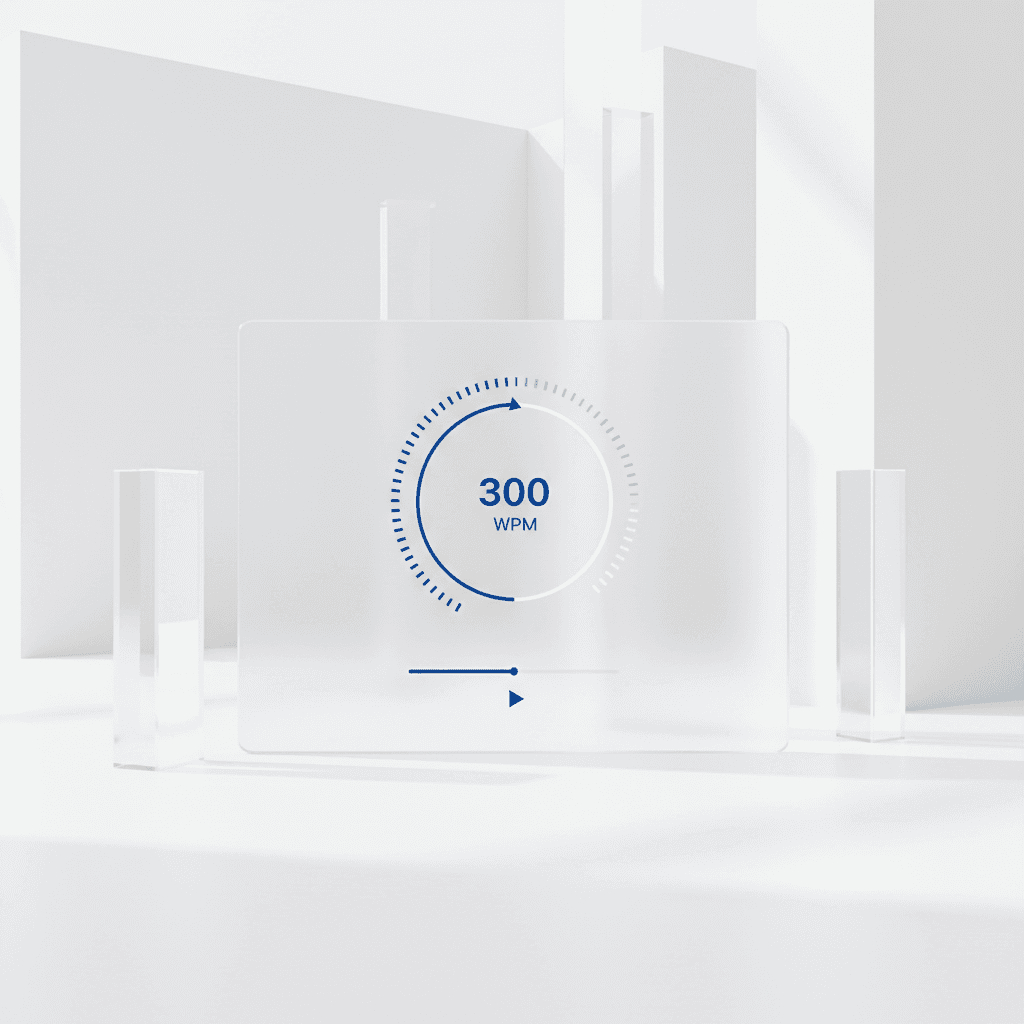
Start at a Comfortable Speed (250-350 WPM)
Begin your RSVP journey at 300 WPM—slightly faster than average traditional reading. This gives your brain time to adapt to the single-word display format without overwhelming it. Upload a familiar text (perhaps a book you've already read) so you can focus on adapting to the technique rather than processing new information. Spend 2-3 sessions at this speed until it feels completely natural.
Lock Your Eyes on the Center Point
Resist the urge to move your eyes. Keep them fixed on the exact center of the screen where words appear. Some readers find it helpful to focus on a specific area—LumaRead highlights the Optimal Recognition Point to guide your focus. If you notice your eyes trying to 'follow' words or anticipate the next one, consciously relax and let the words come to you. This passive reception is the key to RSVP's power.

Trust Your Brain and Silence the Inner Voice
One of the hardest adjustments for new RSVP readers is learning to trust that your brain absorbs meaning without 'hearing' each word internally. This subvocalization (the inner voice that 'says' each word) limits you to speech speed (~150-200 WPM). As you increase speed, you'll naturally begin reading visually rather than auditorily. Don't force it—just focus on understanding the overall meaning, not pronouncing each word mentally.

Increase Speed in Small Increments (25-50 WPM)
Once you're comfortable at 300 WPM (usually after 3-5 sessions), bump up to 350 WPM. Stay at each new speed until comprehension feels solid—you should understand 80-90% of what you read. Continue increasing by 25-50 WPM increments every few sessions. Most users reach 450-500 WPM within the first week and 600+ WPM within 3-4 weeks. Don't rush—sustainable progress beats temporary spikes.

Practice Daily for Lasting Improvement
Consistency beats intensity. Fifteen to twenty minutes of daily RSVP practice with LumaRead will yield better results than hour-long sessions once a week. Your brain needs regular exposure to build and strengthen the neural pathways for visual reading. Try to practice at the same time each day—many users prefer morning sessions with their coffee or evening wind-down reading. Track your progress using LumaRead's statistics dashboard to stay motivated.

Vary Your Material for Well-Rounded Skills
Once you're comfortable with RSVP basics, challenge yourself with diverse content. Read fiction to build speed, non-fiction to test comprehension, and technical material to understand your limits. Different content types require different optimal speeds—you might read a novel at 700 WPM but slow to 400 WPM for a dense academic paper. This flexibility is a feature, not a bug. LumaRead makes speed adjustment seamless so you can adapt on the fly.
💡 Pro Tips
- •Use a quiet environment to minimize distractions—RSVP requires focused attention, especially when you're learning
- •Take breaks every 20-30 minutes to prevent eye fatigue and let your brain consolidate what you've learned
- •Start with familiar content before tackling complex material—this lets you focus on the technique rather than the content
- •Don't worry about missing occasional words—your brain fills in gaps naturally through context, just like in normal reading
- •Use LumaRead's bookmark feature to track your progress across multiple books and documents
- •If comprehension drops significantly, slow down rather than pushing through—speed without understanding is pointless
- •Experiment with LumaRead's phrase mode once you've mastered single-word RSVP—reading 2-3 words at a time can further increase speed
- •Keep your screen at arm's length and ensure good lighting to reduce eye strain during longer sessions
- •Stay hydrated—cognitive tasks like speed reading require mental energy, and dehydration impairs focus
- •Celebrate milestones! Reaching 500 WPM, then 600 WPM, then 700 WPM are all achievements worth acknowledging
Visual Guide


Frequently Asked Questions
RSVP (Rapid Serial Visual Presentation) is a scientifically-validated speed reading technique where words are shown one at a time at a fixed location on your screen. By eliminating the need for eye movements (called saccades), RSVP removes the physical bottleneck that limits traditional reading speed. Originally developed by cognitive psychologists to study attention and perception, RSVP has been refined into a practical reading method used by millions worldwide. LumaRead uses advanced RSVP technology with Optimal Recognition Point positioning to maximize both speed and comprehension.
Results vary by individual, but most LumaRead users reach 500-700 WPM with consistent practice—2-3x faster than the average reading speed of 250-300 WPM. Some dedicated practitioners achieve 1000+ WPM. The key factors are: starting reading speed (slower readers often see the biggest percentage improvements), daily practice consistency (15-20 minutes daily beats sporadic longer sessions), and content familiarity (you'll read faster with material you understand well). Within 2-3 weeks of daily practice, most users double their reading speed.
Research consistently shows that comprehension remains high at speeds up to 500-600 WPM for most readers—that's 2x the average reading speed with equivalent understanding. A 2014 study in Psychological Science found that RSVP readers maintained 75-80% comprehension at 700 WPM. Beyond 600-700 WPM, comprehension may decrease for complex material, though this varies significantly by individual and content type. LumaRead's adjustable speed lets you find your personal sweet spot where speed and comprehension are both optimized. Many users report that RSVP actually improves their comprehension because it forces focused attention and eliminates mind-wandering.
Most people see significant improvement within 1-2 weeks of daily practice (15-20 minutes per day). The learning curve typically follows this pattern: Days 1-3: Adapting to the format, reading at 300-350 WPM; Week 1: Comfortable at 400-500 WPM; Weeks 2-3: Reaching 500-600 WPM with good comprehension; Weeks 4-8: Refining technique, reaching 600-800 WPM. 'Mastery' (defined as being able to read comfortably at 600+ WPM with 80%+ comprehension) typically takes 4-8 weeks of consistent practice. However, you'll benefit from RSVP immediately—even your first session will likely be faster than traditional reading.
RSVP works excellently for linear content—novels, non-fiction books, articles, research papers, and documents. It's particularly effective for content you want to read cover-to-cover. However, RSVP is less suitable for: reference material you need to skip around in, highly technical content with equations or code, content with images/charts integral to understanding, and poetry where line breaks are meaningful. LumaRead is designed for book-length reading where RSVP shines. For other content types, traditional reading may be more appropriate.
Many users with ADHD report that RSVP is actually easier than traditional reading because it forces focus. When words appear at a controlled pace, there's no opportunity for your eyes to wander or your attention to drift. The external pacing structure provided by RSVP can be particularly helpful for readers who struggle with the self-directed attention required by traditional reading. While RSVP isn't a treatment for ADHD, many LumaRead users with attention difficulties find it helps them read more consistently and with better comprehension than traditional methods.
Traditional speed reading methods (like chunking, meta-guiding, or reducing subvocalization) work within the framework of traditional reading—your eyes still move across the page, just faster or more efficiently. These techniques typically yield 25-50% speed improvements. RSVP takes a fundamentally different approach by eliminating eye movement entirely. This removes the physical constraint that limits traditional reading and typically yields 100-200% speed improvements. Think of it this way: traditional speed reading is like optimizing your car's engine; RSVP is like getting a completely different vehicle. Both have their place, but RSVP offers the higher speed ceiling for digital reading.